
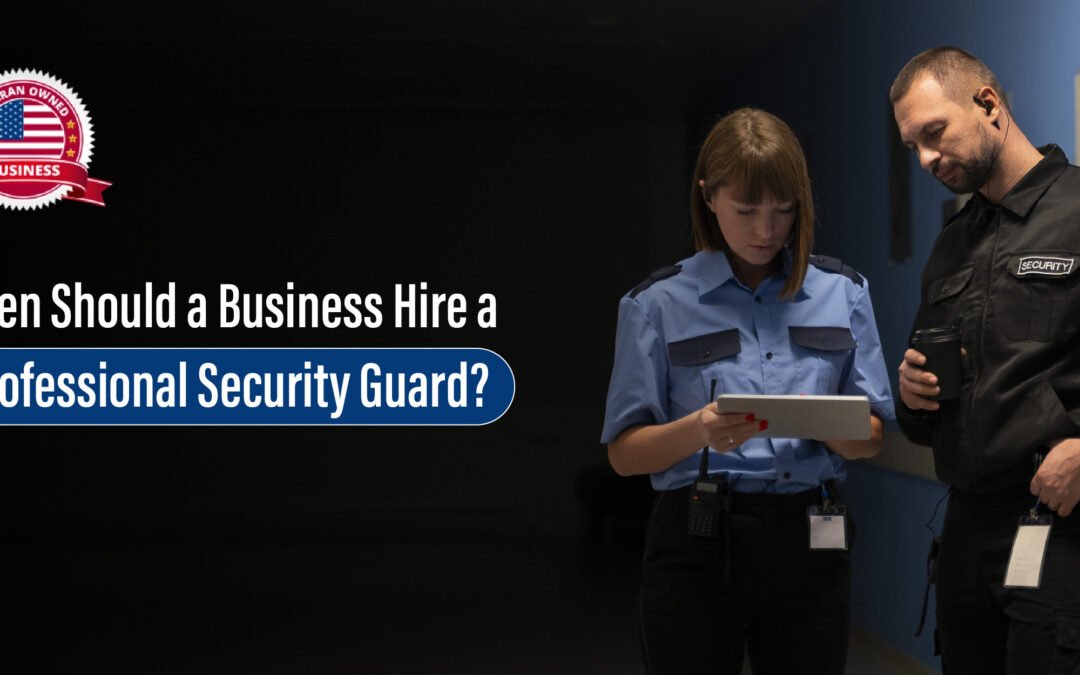
When Should a Business Hire a Professional Security Guard?
Every business owner eventually asks the same question: is it time to bring in professional security, or can existing measures like cameras and alarm systems handle the job? The answer isn’t the same for every business, but there are clear signals that point to when hiring a security guard stops being optional and starts being necessary. This blog breaks down those signals, explains what professional security guard services actually cover, and helps you evaluate whether your business has reached that turning point.
Why This Question Matters More Than Ever
Businesses today face a wider range of risks than they did even a decade ago. Theft, vandalism, workplace violence, unauthorized access, and liability claims are all rising concerns for companies of every size. A locked door and a security camera can document an incident after it happens, but they can’t stop it in real time. That’s the fundamental difference a trained security guard brings to the table — an active, responsive presence rather than a passive recording device.
Understanding when to hire a security guard requires looking at your business from a few different angles: the nature of your operations, the value of what you’re protecting, your foot traffic, your location, and your history with incidents. Let’s go through each of these in detail.
Signs Your Business Needs Professional Security Guard Services
1. You Handle Cash, Inventory, or High-Value Assets
Retail stores, jewelry shops, warehouses, and cash-heavy businesses like banks or check-cashing outlets are natural targets for theft. If your business regularly handles significant amounts of cash, expensive merchandise, or sensitive inventory, this is one of the clearest indicators that it’s time to hire a security guard. A visible security presence acts as a deterrent long before any incident occurs, and trained guards know how to monitor high-risk areas like registers, loading docks, and storage rooms without disrupting daily operations.
2. Your Business Has Experienced Theft, Vandalism, or Break-Ins
Past incidents are one of the strongest predictors of future ones. If your business has already dealt with shoplifting, employee theft, vandalism, or break-ins, that history alone justifies bringing in commercial security guard services. Guards don’t just react to problems — they identify vulnerabilities in your current setup, such as blind spots in camera coverage, weak entry points, or predictable patterns in staff schedules that could be exploited.
3. You Manage a Large Facility or Multiple Entry Points
Warehouses, distribution centers, office complexes, and construction sites often have multiple doors, loading bays, and access points that are difficult to monitor with cameras alone. Security guards for businesses with sprawling or multi-entry facilities provide the boots-on-the-ground coverage needed to control who comes and goes, checking credentials and preventing unauthorized access in ways that automated systems can’t replicate on their own.
4. Your Business Deals With High Foot Traffic
Shopping centers, hotels, event venues, and busy restaurants see a constant flow of visitors, which naturally increases the potential for conflicts, accidents, or disruptive behavior. Business security services in these environments aren’t just about preventing crime — they’re about managing crowds, de-escalating tense situations, and ensuring customers feel safe. A visible guard at the entrance or patrolling common areas reassures visitors and reflects well on your brand’s commitment to safety.
5. Workplace Conflicts or Safety Concerns Have Increased
Sometimes the threat isn’t external. Disgruntled employees, contentious terminations, domestic disputes spilling into the workplace, or general tension among staff can escalate into safety issues. Workplace security services are designed to handle these situations professionally, providing a calm, authoritative presence that can prevent conflicts from turning physical and ensuring that any incidents are handled according to protocol rather than improvised in the moment.
6. Your Location Has Higher Crime Rates or Limited Law Enforcement Response Times
Businesses located in areas with historically higher crime rates, or in regions where police response times tend to be longer, benefit significantly from an on-site security presence. Waiting 10, 15, or 20 minutes for law enforcement to arrive during an active incident can be the difference between a contained situation and a serious one. A professional guard on-site can intervene immediately, manage the situation, and coordinate with law enforcement once they arrive.
7. You’re Hosting a Special Event
One-time events — grand openings, product launches, corporate parties, or seasonal sales — often draw larger crowds than a business normally sees. Even if your day-to-day operations don’t require a permanent guard, temporarily hiring a security guard service for the event itself can help manage crowd flow, monitor entry points, and respond quickly if something goes wrong.
8. Insurance or Compliance Requirements Call for It
Some industries and insurance policies require a documented security presence as a condition of coverage or compliance. If your insurer has flagged security as a requirement, or if your industry has regulatory standards around asset protection and employee safety, hiring a guard isn’t just a good idea — it’s a necessity.
What Professional Security Guard Services Actually Include
It helps to understand the full scope of what you’re paying for when you bring in commercial security guard services. These aren’t limited to simply “standing watch.” A well-trained guard typically provides:
- Access control — verifying identification, checking credentials, and managing who enters and exits a property.
- Patrol services — regular walkthroughs of interior and exterior spaces to check for hazards, unlocked doors, or suspicious activity.
- Incident response — the ability to de-escalate conflicts, detain individuals when legally appropriate, and coordinate with police or emergency services.
- Surveillance monitoring — working alongside camera systems to actively respond to alerts rather than just recording footage.
- Customer service — for many businesses, guards also serve as the first point of contact for visitors, offering directions, answering questions, and creating a welcoming yet secure environment.
- Documentation and reporting — maintaining detailed logs of incidents, visitor activity, and daily observations, which can be critical for liability protection and insurance claims.
Understanding these responsibilities makes it easier to see why guards are considered an investment rather than an expense. They combine deterrence, active monitoring, and rapid response in a way that no single piece of technology can replicate.
Weighing the Cost Against the Risk
One of the most common hesitations business owners have is cost. Hiring a security guard is an ongoing operational expense, and it’s fair to weigh that cost against your actual risk level. A small office in a low-crime area with no cash on hand may not need a full-time guard. But a retail store in a high-traffic shopping district, a warehouse storing valuable inventory, or a business that has already experienced a break-in has a very different risk profile.
The real question to ask isn’t just “what does it cost to hire a guard,” but “what does it cost if something goes wrong without one?” Theft, workplace violence, liability lawsuits, and reputational damage all carry costs that often exceed what security guard services for businesses would have cost in the first place. Many businesses find that the benefits of hiring security guards — reduced theft, safer employees, fewer liability incidents, and improved customer confidence — significantly outweigh the recurring cost.
Full-Time vs. Part-Time vs. Event-Based Security
Not every business needs a guard stationed on-site around the clock. Depending on your risk profile, you might consider:
- Full-time coverage for businesses with continuous operations, high-value assets, or 24-hour facilities like warehouses and manufacturing plants.
- Part-time or shift-based coverage for businesses that only need protection during peak hours, such as retail stores during business hours or offices during after-hours cleaning shifts.
- Event-based coverage for one-off situations like grand openings, holiday sales, or corporate functions.
A reputable security provider will assess your specific operations and recommend a coverage plan that matches your actual risk rather than pushing a one-size-fits-all package.
How to Evaluate a Security Guard Provider
Once you’ve decided that hiring a guard makes sense, choosing the right provider matters just as much as the decision itself. Look for:
- Licensing and certification — guards should be properly licensed in the state where they operate, with training in areas like conflict de-escalation, emergency response, and legal boundaries around detainment.
- Industry experience — a provider with experience in your specific industry (retail, healthcare, construction, hospitality) will understand the unique risks you face.
- Clear communication and reporting — you should receive regular updates, incident reports, and have an easy way to communicate with both guards and management.
- Customization — the best providers tailor coverage to your facility’s layout, hours, and risk factors rather than offering a generic package.
- Reputation and reviews — client testimonials and case studies can tell you a lot about reliability and professionalism.
Partnering With the Right Security Team
Choosing to invest in professional protection is only half the equation — the other half is choosing a provider you can trust to execute it well. Citizens’ Guard Security offers professional security guard services designed around the specific needs of each business, whether that means daily patrols for a retail location, dedicated coverage for a warehouse, or event-based support for a one-time gathering. The company traces its roots back to 2013, when it was founded as Citizens’ Security before evolving into Citizens’ Guard Security under Citizens’ Investigation, LLC. That foundation was built on decades of combined experience across military, law enforcement, and investigative work, and it continues to shape a mission centered on professionalism, accountability, and genuine customer service.
Citizens’ Guard Security provides security solutions across multiple states, including Alabama, Tennessee, Florida, Indiana, Kentucky, and Missouri, giving businesses in these regions a dependable partner for commercial security guard services, workplace security services, and everything in between. Based at 100 S 4th St Suite 550, St. Louis, MO 63102, the team is ready to help you assess your risk and build a security plan that actually fits your business.
Frequently Asked Questions
1. How do I know if my business actually needs a security guard, or if cameras and alarms are enough?
Cameras and alarms are useful for documenting and detecting incidents, but they can’t physically intervene. If your business handles cash or high-value inventory, has multiple entry points, sees high foot traffic, or has already experienced theft or vandalism, a professional security guard adds a layer of active protection that technology alone can’t provide.
2. What’s the difference between full-time, part-time, and event-based security guard coverage?
Full-time coverage suits businesses with continuous operations or valuable assets on-site around the clock, like warehouses or manufacturing plants. Part-time coverage works well for businesses that only need protection during specific hours, such as retail stores during business hours. Event-based coverage is ideal for one-time situations like grand openings or corporate functions where you need temporary extra security.
3. Are professional security guards trained to handle workplace conflicts, not just theft or break-ins?
Yes. Reputable security guard providers train their staff in conflict de-escalation and emergency response, not just surveillance and patrol. This makes them well-suited to managing tense workplace situations, contentious terminations, or disputes among staff or customers, in addition to preventing theft and unauthorized access.
4. How much does it cost to hire a security guard for a business?
Costs vary based on factors like coverage hours, number of guards needed, facility size, and location. Rather than focusing only on the upfront cost, weigh it against the potential cost of theft, liability claims, or safety incidents that could occur without a security presence.
5. What should I look for when choosing a security guard provider?
Look for proper state licensing, documented training in de-escalation and emergency protocols, experience in your specific industry, clear incident reporting, and a willingness to customize coverage to your facility rather than offering a one-size-fits-all package. Client reviews and case studies can also help confirm reliability.