
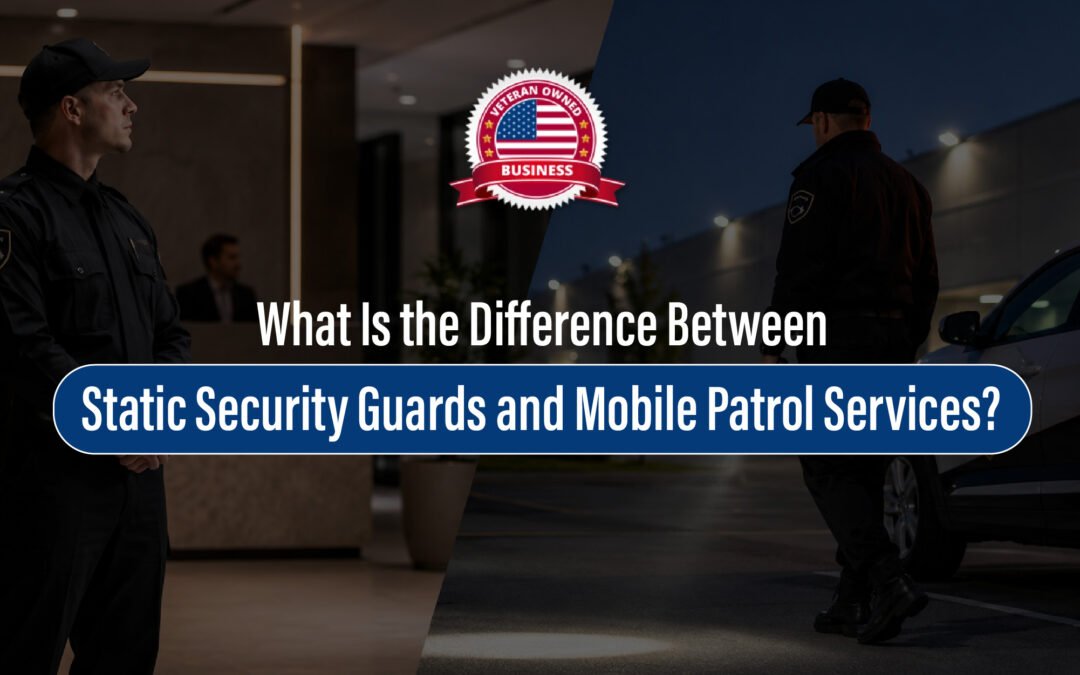
What Is the Difference Between Static Security Guards and Mobile Patrol Services?
When business owners start researching protection options, one of the first decisions they run into is whether to choose static security guards or mobile patrol services. Both fall under the umbrella of professional security, but they operate very differently, serve different purposes, and fit different types of properties. Understanding the distinction is essential to making the right choice for your business, your budget, and your risk profile. This blog breaks down exactly how each option works, where each one shines, and how to decide which — or which combination — makes the most sense for you.
What Are Static Security Guards?
Static security guards, sometimes called stationary guards, are assigned to a single, fixed location for the duration of their shift. Whether that’s the front entrance of an office building, the gate of a warehouse, or the lobby of a retail store, a static guard remains at that post, actively monitoring the area, checking credentials, and responding immediately to anything unusual.
Because they stay in one place, static guards develop a detailed familiarity with their assigned site. They learn the regular patterns of employees, vendors, and visitors, which makes it easier to spot something out of place — an unfamiliar face, an unusual delivery, or behavior that doesn’t fit the norm. This constant presence also acts as a strong visual deterrent; potential wrongdoers are far less likely to attempt theft or unauthorized entry when they see a guard stationed right at the point of access.
Static security guards are typically found in:
Events with a fixed perimeter, like conferences or private functions
- Retail stores and shopping centers
- Corporate offices and reception areas
- Warehouses and distribution centers
- Apartment complexes and gated communities
- Construction sites with a single main entry point
- Events with a fixed perimeter, like conferences or private functions
What Are Mobile Patrol Services?
Mobile patrol services work differently. Instead of staying in one location, a mobile patrol guard travels between multiple properties or across a large site, usually in a marked vehicle, conducting scheduled or randomized checks. Mobile patrols are especially useful for businesses that don’t require a guard on-site at all times but still need regular monitoring, especially during off-hours like overnight or weekends.
A mobile patrol officer might check on a property several times throughout a shift, inspecting locks, verifying that alarm systems are functioning, walking the perimeter, and looking for signs of forced entry, vandalism, or suspicious loitering. Because the timing of each visit can be randomized, mobile patrols create unpredictability that makes it harder for anyone to plan around a guard’s schedule — a key advantage over a fixed, predictable static post.
Mobile patrol services are commonly used for:
- Multiple properties owned by the same business or property management company
- Large industrial parks or storage facilities
- Parking lots and parking structures
- Vacant or under-construction properties
- Businesses that need after-hours coverage but not a full-time on-site presence
- Neighborhoods or business districts requiring periodic drive-through checks
Key Differences Between Static and Mobile Security
When comparing static vs mobile security directly, a few core differences stand out:
1. Coverage Area: Static guards are dedicated to one location. Mobile patrols cover multiple locations or a wide area, moving from site to site based on a set route or schedule.
2. Presence and Visibility: A static guard offers constant, visible presence at a single point, which can be reassuring for employees and customers who see the same guard daily. Mobile patrols provide visibility too, but it’s intermittent — visible during each check-in rather than continuously.
3. Cost Structure: Static guard services are generally billed per guard, per hour, for continuous coverage at one site. Mobile patrol services are often billed per visit, per route, or as a flat rate for a set number of checks per week, which can make them more cost-effective for businesses that don’t need round-the-clock, single-site coverage.
4. Response Time: Static guards can respond to an incident the moment it happens since they’re already on-site. Mobile patrols may take a few minutes to arrive if an alarm triggers between scheduled checks, though many patrol services include rapid-response capabilities for exactly this kind of situation.
5. Best Use Case: Static security guards for businesses work best where consistent, visible protection at a single access point is critical — think busy retail entrances or corporate lobbies. Mobile patrol services work best where the risk is spread across a wider area or where full-time, on-site staffing isn’t cost-effective or necessary.
The Case for Static Security Guards
There are situations where nothing replaces having someone physically present. If your business deals with high-value inventory, cash handling, or heavy foot traffic, a static guard provides immediate, ongoing oversight. They can check IDs, monitor for shoplifting, manage entry during busy hours, and respond instantly if a conflict arises. For businesses in industries like retail, hospitality, or corporate offices where customer-facing security matters, a stationed guard also contributes to the overall sense of professionalism and safety that customers and employees notice.
Static guards are also valuable in environments where relationship-building matters — a familiar face at the front desk who knows the regular employees, understands the building’s layout, and can quickly flag anything unusual builds a level of trust that rotating mobile patrols can’t replicate as easily.
The Case for Mobile Patrol Services
On the other hand, mobile patrol services shine in situations where a full-time, single-location guard isn’t practical or necessary. If you manage several properties, a large parking lot, or a facility that’s mostly unoccupied overnight, paying for a guard to stand at one spot around the clock may not be the most efficient use of your security budget. Instead, scheduled or randomized patrol visits provide meaningful coverage without the cost of continuous staffing.
One of the underappreciated benefits of mobile patrol security is the unpredictability factor. Because patrol times aren’t fixed, it’s much harder for anyone with bad intentions to anticipate when a guard will show up next, which adds a layer of deterrence that a predictable, fixed schedule doesn’t offer. Mobile patrols are also well-suited for businesses that need coverage across a portfolio of properties, since a single patrol officer can efficiently check on several locations in one shift rather than requiring a dedicated guard at each site.
Can You Combine Both Approaches?
Many businesses find that the best security patrol services strategy isn’t choosing one option exclusively, but combining both. For example, a retail chain might use static guards during business hours at their busiest locations while relying on mobile patrols for overnight checks across all their stores. A corporate campus might station a guard at the main entrance while using mobile patrols to monitor parking structures and secondary buildings scattered across the property.
This layered approach allows businesses to allocate security resources based on actual risk and traffic patterns rather than applying a single method across every location and every hour of the day. A professional security guard services provider can help assess your specific footprint and recommend the right mix.
Questions to Ask When Deciding Between Static and Mobile Security
Before you hire a security guard or commit to a patrol contract, consider the following:
- How much foot traffic does your location see, and during what hours? High-traffic, high-visibility locations often benefit more from static coverage.
- Do you operate multiple sites? If so, mobile patrols may offer more efficient coverage across your entire portfolio.
- What’s your risk during off-hours? Overnight vulnerability at an otherwise quiet property is a classic use case for mobile patrol checks.
- What’s your budget? Continuous static coverage costs more than periodic patrol visits, so weigh the actual risk against what you’re able to invest.
- Do you need a visible deterrent, a rapid response capability, or both? Some businesses need constant visibility; others just need to know someone is checking in regularly.
Making the Right Choice for Your Business
There’s no universal answer to whether static security guards or mobile patrol services are “better” — it depends entirely on your property, your risk factors, and your operational needs. A single-location retail store with high foot traffic will likely benefit most from a dedicated, on-site guard. A business with several properties spread across a region, or a facility with minimal activity overnight, is often better served by scheduled mobile patrols. Many businesses ultimately land on a hybrid model that uses both, tailored to specific times, locations, and risk levels.
Whichever direction fits your business, working with a provider that offers both commercial security guard services and mobile patrol options gives you the flexibility to adjust your coverage as your needs change, rather than being locked into a single approach that may not fit every part of your operation.
Partnering With Citizens’ Guard Security
Deciding between static security guards for businesses and mobile patrol services doesn’t have to be complicated when you have a knowledgeable partner guiding the process. Citizens’ Guard Security offers both options, along with the flexibility to combine them based on your property’s specific layout, traffic patterns, and risk profile. The company’s roots go back to 2013, when it was founded as Citizens’ Security before evolving into Citizens’ Guard Security under Citizens’ Investigation, LLC. That history is grounded in decades of combined experience across military, law enforcement, and investigative work, shaping a mission built on professionalism, accountability, and genuine customer service. Citizens’ Guard Security provides security solutions across multiple states, including Alabama, Tennessee, Florida, Indiana, Kentucky, and Missouri, giving businesses in these regions a dependable partner whether they need a dedicated guard at the front door or scheduled patrol checks across multiple properties. The team is ready to help assess your risk and recommend the coverage that actually fits your business.
Citizens’ Guard Security
100 S 4th St Suite 550,
St. Louis, MO 63102, United States
Frequently Asked Questions
1. Which is more cost-effective — static guards or mobile patrols?
Mobile patrols are usually more cost-effective since they’re billed per visit rather than continuous staffing. Static guards cost more but offer constant on-site presence, which pays off for high-traffic locations.
2. Can a business use both static guards and mobile patrols together?
Yes. Many businesses combine both — a static guard during business hours and mobile patrols for overnight checks across properties — for layered, cost-efficient coverage.
3. How fast can mobile patrols respond to an alarm?
Response times vary by provider, but most mobile patrol services include rapid-response protocols for alarms between scheduled checks. Static guards respond instantly since they’re already on-site
4. Are mobile patrols less effective since they’re not always present?
Not necessarily. Randomized patrol timing makes guard visits unpredictable, which still deters wrongdoing even without a constant physical presence.
5. Which businesses benefit most from static guards vs. mobile patrols?
Static guards suit single, high-traffic sites like retail stores or lobbies. Mobile patrols work better for multiple properties, large lots, or facilities mostly unoccupied after hours.